
Last Updated: July 30, 2026
Reading Time: 11 minutes
Prepared by: Basta Vape Editorial Team
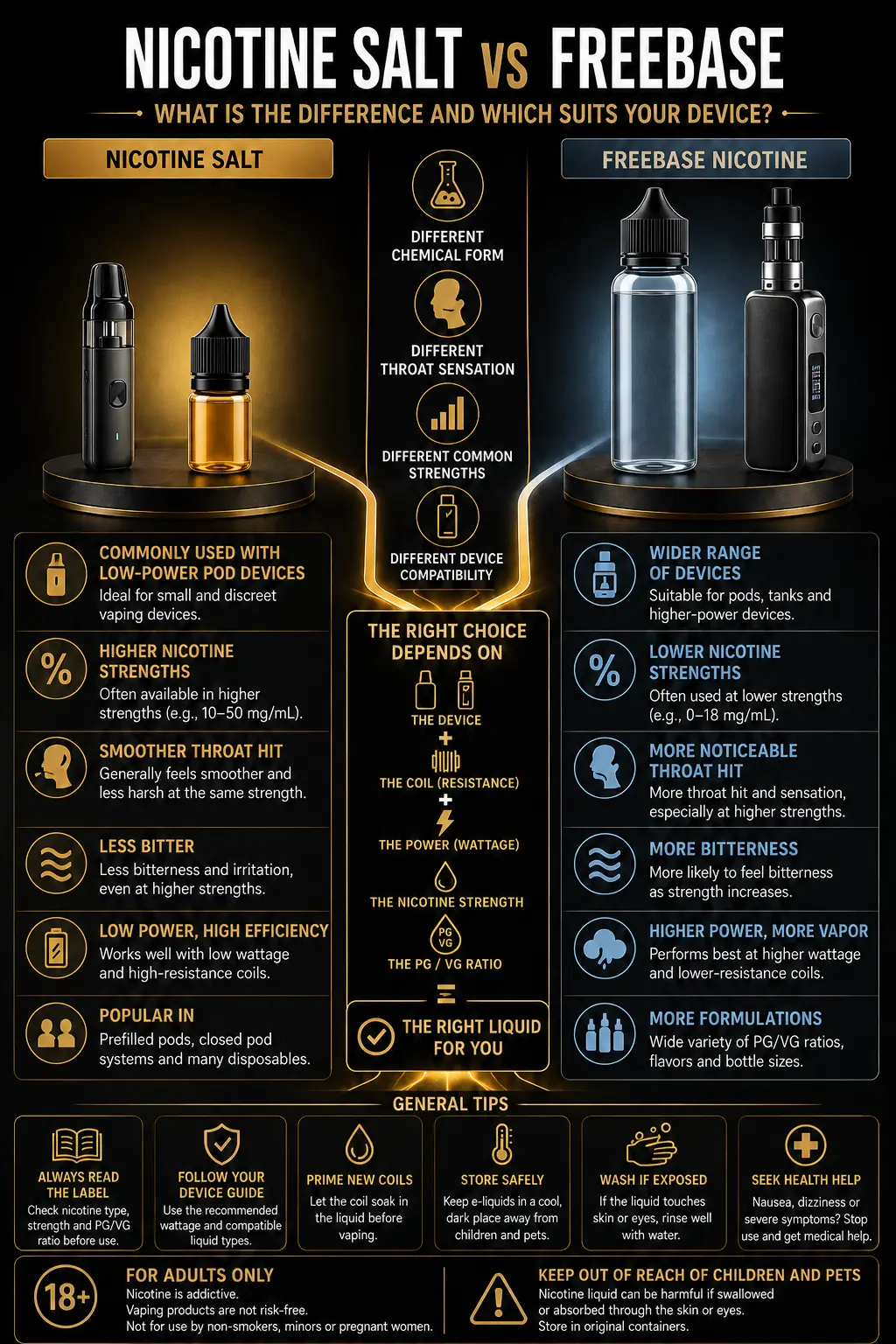
Nicotine salt and freebase nicotine differ in their chemical form, typical throat sensation, commonly available strengths and the types of devices with which they are usually used.
Nicotine salt is not automatically stronger in every situation, and freebase is not always lighter. The amount of nicotine produced by a device depends on several factors working together, including the liquid strength, device power, coil resistance, PG/VG ratio and usage pattern.
This guide is intended only for adults who already use tobacco or nicotine products. It does not encourage non-users to begin. Nicotine is addictive, and vaping products are not risk-free. Saudi Arabia’s Anti-Smoking Law also prohibits selling tobacco products to anyone under 18.
Quick Answer
Nicotine salt contains nicotine that has been combined with an organic acid, converting part of it into a protonated or ionized form. Compared under similar conditions, this generally produces a smoother and less bitter throat sensation than freebase nicotine at the same strength.
Freebase nicotine is the non-protonated form of nicotine. Its throat sensation usually becomes more noticeable as the nicotine strength increases. It is available for a broad range of liquids and devices and is commonly used at lower strengths in higher-power devices.
In practical terms:
- Nicotine salt is commonly used with low-power pod devices
- Freebase is common in refillable pods, tanks and higher-power devices, particularly at lower nicotine strengths
- Do not use a high-strength liquid in a powerful device simply because the tank can be filled with it
- Do not select a liquid based only on the words “salt” or “freebase.
- Check nicotine strength, PG/VG ratio, coil resistance, recommended power range and manufacturer instructions
Quick Comparison
| Comparison factor | Nicotine salt | Freebase nicotine |
|---|---|---|
| Chemical form | Partly protonated using an organic acid | Nicotine in its free form |
| Typical throat sensation | Usually smoother at the same strength | Usually more noticeable as strength increases |
| Common use | Low-power pod devices | Wider device range, including higher-power systems |
| Commonly available strengths | Often relatively higher | Often lower in high-power liquids |
| Flexibility | Depends on device compatibility | Available in a broader range of formulations |
| Aerosol production | Determined by device, PG/VG and power | Determined by device, PG/VG and power |
| Correct choice | Based on device and coil specifications | Based on device and coil specifications |
Market patterns suggest that nicotine salt is especially common in pod-related liquids and is often sold at higher nicotine strengths than freebase. These are general market trends, not universal compatibility rules.
Table of Contents
- What is nicotine in vape liquid?
- What is nicotine salt?
- What is freebase nicotine?
- The chemical difference
- Throat sensation and smoothness
- Is nicotine salt stronger?
- Nicotine strength and device power
- Which suits pod devices?
- Which suits higher-power devices?
- Coil resistance and power
- The role of PG and VG
- How to read an e-liquid label
- Signs that your choice may be unsuitable
- Common mistakes
- Final decision table
- Pre-use checklist
- Frequently asked questions
What Is Nicotine in Vape Liquid?
Nicotine is an addictive substance found in most nicotine-containing vaping products. Repeated exposure can create dependence, cravings and difficulty stopping use.
Changing nicotine from freebase to salt does not remove its addictive properties.
Vape liquid generally contains a mixture of:
- Propylene glycol, commonly abbreviated as PG
- Vegetable glycerin, commonly abbreviated as VG
- Flavorings and other ingredients
- Nicotine, when included
The nicotine strength printed on the bottle does not determine nicotine exposure by itself. Delivery may vary depending on device power, coil design, puff duration, PG/VG ratio and usage pattern.
A low-strength liquid used in a high-output device may produce a very different experience from a higher-strength liquid used in a small, low-power pod.
What Is Nicotine Salt?
Nicotine salt is a formulation in which nicotine is combined with an organic acid. This changes a larger portion of the nicotine from its free form into a protonated or ionized form.
Formulations may use acids such as:
- Benzoic acid
- Lactic acid
- Malic acid
- Other organic acids
The word salt does not mean that the liquid contains table salt. It describes the chemical form created when nicotine reacts with an acid.
Why Is Nicotine Salt Used?
Nicotine salt formulations generally allow higher nicotine strengths to produce less throat harshness and bitterness than freebase nicotine at the same strength.
For this reason, nicotine salt has become common in:
- Small pod devices
- Low-power devices
- Prefilled pod systems
- Many modern disposable devices
A smoother sensation does not mean that the liquid contains less nicotine or carries fewer risks. It may simply make the nicotine strength less noticeable through throat sensation alone.
What Is Freebase Nicotine?
Freebase is the free or non-protonated form of nicotine. It was the most common nicotine form in many traditional vape liquids before pod systems and nicotine salts became widespread.
As freebase strength increases, throat sensation, harshness and bitterness may become more noticeable.
This is one reason freebase is commonly used at lower strengths in devices that produce larger quantities of aerosol or operate at higher power.
Freebase liquids are available across a broad range of:
- PG/VG ratios
- Nicotine strengths
- Tank-oriented liquids
- Open pod systems
- Coil resistances and device types
However, the word freebase on a bottle does not automatically mean the liquid is suitable for every device. Its viscosity, nicotine strength and formulation must still match the pod, coil and recommended power range.
What Is the Chemical Difference?
The main difference concerns nicotine’s chemical state and the acidity of the formulation.
Freebase Nicotine
A larger proportion of the nicotine remains in its free, non-protonated form.
This form is generally associated with a more noticeable throat sensation and bitterness, particularly at higher strengths.
Nicotine Salt
An organic acid is added, converting a larger proportion of the nicotine into its protonated form.
The lower pH and changed chemical balance generally reduce the perceived harshness and bitterness.
However, “smoother” does not mean:
- Risk-free
- Lower in nicotine
- Less addictive
- Suitable for every device
- Appropriate to use in larger quantities
A smooth liquid may still contain a high nicotine concentration. Always read the strength printed on the packaging rather than judging the product by sensation alone.
How Do They Differ in Throat Sensation?
Nicotine Salt
When equal strengths are compared under similar conditions, nicotine salt is commonly described as:
- Smoother
- Less harsh
- Less bitter
- Easier for some users to inhale
Not every salt liquid will feel identical. Flavoring, PG/VG ratio, device power and coil design also affect the experience.
Freebase Nicotine
Freebase may provide:
- A more noticeable throat sensation
- Greater harshness as nicotine strength increases
- Suitability for lower strengths in high-output devices
- A wider variety of PG/VG formulations
Personal sensation is not an accurate measurement of nicotine delivery
A liquid may feel smooth despite having a high nicotine strength. Another may feel harsher because of its PG content, flavoring or device settings rather than nicotine strength alone.
Is Nicotine Salt Stronger Than Freebase?
The name alone cannot answer this question.
The practical strength of the experience depends on three different factors:
- The nicotine concentration printed on the bottle
- The quantity of liquid converted into aerosol by the device
- The amount absorbed by the user and the way the device is used
Device power and liquid composition can substantially affect nicotine output.
In controlled human-use research, some nicotine-salt formulations delivered more nicotine than freebase formulations at the same printed strength when used under similar device conditions.
This means the actual experience may depend on the interaction between:
- Nicotine formulation
- Device design
- Throat sensation
- Puff duration
- User behavior
Therefore:
Likewise, do not assume that a low-strength liquid in a powerful device will always deliver less nicotine than a higher-strength liquid in a low-power device.
Nicotine Strength and Device Power
As device power increases, the device can generally convert more liquid into aerosol over the same period.
As the nicotine concentration increases, each quantity of aerosol may contain more nicotine.
Power and strength must therefore be considered together.
Simplified Example
Small, Low-Power Device
- Produces a relatively limited quantity of aerosol per puff
- Commonly uses a higher-resistance pod or coil
- Often uses nicotine-salt liquids at relatively higher strengths
Higher-Power Device
- Can convert more liquid into aerosol
- Commonly uses a lower-resistance coil
- Often uses lower nicotine strengths, particularly freebase liquids
This is a general pattern, not permission to experiment without guidance.
Follow the manufacturer’s recommendations for the device, pod, coil and liquid type.
Important Warning
Do not use high-strength nicotine salt in a high-power device or low-resistance coil unless the manufacturer explicitly confirms that the combination is suitable.
A device producing a large quantity of aerosol may significantly increase nicotine exposure, even when the liquid does not feel particularly harsh.
Which Type Suits Pod Devices?
The answer depends on the pod system.
Closed or Prefilled Pod
The user does not normally choose the liquid because the pod arrives with a fixed formulation.
Use only the original compatible pod. Do not open or refill a closed pod unless its manufacturer specifically designed it for that purpose.
Low-Power, Higher-Resistance Pod
Nicotine salt is common in this category.
Small pod systems produce a relatively limited quantity of aerosol, while nicotine-salt formulations generally allow a higher nicotine strength with a smoother throat sensation.
Refillable, Medium-Power Pod
Depending on the specific pod and coil, it may support:
- Low- or moderate-strength nicotine salt
- Low-strength freebase
- Liquids specifically formulated for pod devices
Compatibility depends on:
- Pod resistance
- Device output
- Recommended wattage
- Liquid-feed design
- Manufacturer instructions
Do not use a liquid merely because a seller or another user calls it “pod liquid.” Check the specifications of your exact device and coil.
Which Type Suits Higher-Power Devices?
Higher-power devices and tanks with lower-resistance coils generally produce more aerosol.
They are therefore commonly associated with:
- Lower nicotine strengths
- Freebase nicotine liquids
- Higher VG ratios in some products
- Greater airflow and power adjustment
Users of adjustable tank devices generally use lower nicotine concentrations than users of small pod or disposable devices.
However, not every freebase liquid is automatically suitable for every powerful device.
The liquid’s viscosity must match the tank and coil, and the device should remain within the power range printed on the coil or specified by the manufacturer.
What Role Do Coil Resistance and Power Play?
Coil resistance is measured in ohms, but the resistance number does not work independently.
Also consider:
- Coil design
- Heating surface area
- Recommended wattage
- Airflow
- Liquid-feed openings
- Device settings
Coils operating at higher power usually convert more liquid into aerosol, which can increase nicotine output.
Do not rely only on the simplified rule:
This can be a useful starting point, but modern pod systems do not always follow the traditional division.
The device and coil instructions remain the final reference.
What Role Do PG and VG Play?
PG and VG are the two primary liquid carriers. Their ratio affects viscosity, throat sensation, aerosol density and how efficiently the wick receives liquid.
PG
Higher PG ratios are generally associated with:
- Lower viscosity
- A more noticeable throat sensation
- Faster movement through small liquid-feed openings
- Different nicotine-delivery characteristics
VG
Higher VG ratios are generally:
- More viscous
- Associated with denser aerosol in many devices
- Better suited to coils designed for thicker liquids
A high-VG liquid used in a small pod that was not designed for it may cause:
- Slow liquid delivery to the coil
- Reduced performance
- A burnt taste
- More frequent dry hits
A low-viscosity liquid used in an unsuitable pod may cause:
- Leaking
- Excess condensation
- Liquid escaping through the airflow openings
These symptoms can also result from damaged components, incorrect filling or unsuitable power settings, so the PG/VG ratio should not be treated as the only possible cause.
How to Read an E-Liquid Label
Before using a liquid, look for the following information.
1. Nicotine Type
It may appear as:
- Nicotine Salt
- Nic Salt
- Salt Nicotine
- Freebase Nicotine
- Freebase
Do not use the bottle color, branding or flavor name to determine the nicotine type.
2. Nicotine Strength
It is commonly written as:
mg/mL
It may also appear as a percentage.
Some bottles display:
- 20 mg/mL alongside 2%
- 50 mg/mL alongside 5%
However, packaging and calculation methods can vary. Use the complete printed information and manufacturer guidance as the final reference.
3. PG/VG Ratio
It may appear as:
50PG / 50VG
or:
30PG / 70VG
Check whether the ratio is suitable for your pod and coil.
4. Bottle Size
Bottle size does not determine nicotine concentration.
A larger bottle does not automatically contain a stronger or weaker liquid.
5. Warnings and Storage Instructions
Check for:
- A child-resistant cap
- Intact packaging
- A batch number when available
- Production or expiry information
- Storage instructions
- Nicotine warnings
6. Source and Authenticity
Do not use a liquid that is:
- From an unknown source
- Transferred into another container
- Missing clear product information
- Unusually changed in color or smell
- Leaking or supplied with a broken seal
Signs That Your Choice May Not Be Suitable
The following issues do not prove that the nicotine type is wrong, but they are reasons to stop and inspect the device, liquid and settings.
Persistent Burnt Taste
Possible causes include:
- A coil that was not allowed to absorb liquid
- Liquid that does not reach the wick quickly enough
- Power set above the recommended range
- A worn pod or coil
Repeated Leaking
Possible causes include:
- A liquid that is too thin for the pod
- A cracked or damaged pod
- Overfilling
- An open or poorly sealed filling port
- Temperature or pressure changes
Unusually Harsh Sensation
Possible causes include:
- Excessive nicotine strength
- High-strength freebase
- A high PG ratio
- Unsuitable power
- A damaged coil
Nausea, Dizziness or Headache
These may occur with excessive nicotine exposure.
More serious nicotine exposure may also involve vomiting, confusion, poor coordination, breathing difficulty, seizures or loss of consciousness.
Stop using the product when concerning symptoms appear. Seek medical advice if symptoms are severe or persistent, and obtain urgent medical help for breathing difficulty, seizures, severe confusion or unconsciousness.
Common Liquid-Selection Mistakes
Choosing by Flavor Alone
A flavor may be appealing while the nicotine strength or viscosity remains unsuitable for your device.
Assuming Nicotine Salt Is Safe Because It Feels Smoother
Smoothness is a sensory quality. It does not indicate lower risk, lower nicotine content or reduced addiction potential.
Using a High Strength in a Powerful Device
Combining higher device power with a high nicotine concentration may substantially increase nicotine output.
Using High-Strength Freebase to Copy a Salt Experience
This may create excessive harshness and does not guarantee a similar experience because the chemical forms differ.
Relying Only on Coil Resistance
Also check the recommended wattage, pod design and manufacturer instructions.
Ignoring PG/VG Ratio
A liquid that is too thick or too thin may not perform correctly in every pod.
Mixing Liquids Randomly
Mixing liquids changes:
- Nicotine concentration
- PG/VG ratio
- Flavor balance
- Final compatibility
Do not mix products unless you understand their ingredients, calculations and compatibility.
Transferring Liquid to Another Container
Keep e-liquids in their original containers and away from children and animals.
Liquid nicotine may cause harm if swallowed or absorbed through the skin or eyes.
Buying Liquid from an Unknown Source
The label, bottle and seller are important for verifying nicotine strength, ingredients and intended use.
Final Decision Table
| Your situation | More common choice |
|---|---|
| Small, low-power pod | Compatible nicotine salt in many cases |
| Closed pod system | Use the original pod only |
| Open, medium-power pod | Salt or freebase according to specifications |
| Higher-power tank | Lower-strength freebase in many cases |
| Low-resistance coil | Avoid high strengths without clear manufacturer guidance |
| You prefer a smoother throat sensation | Salt may feel smoother at the same strength |
| You prefer a more noticeable throat sensation | Freebase may feel more pronounced |
| You want a high-VG liquid | Confirm the coil supports the viscosity |
| You cannot confirm compatibility | Do not use the liquid until specifications are checked |
This table is general guidance, not a personalized nicotine recommendation.
A Six-Step Selection Plan
1. Identify Your Device Type
Is it a:
- Closed pod?
- Refillable pod?
- Tank?
- Low- or high-power device?
2. Read the Pod or Coil Specifications
Record:
- Resistance
- Recommended wattage
- Product-series name
- Liquid guidance, when provided
3. Check the Nicotine Type
Is the liquid:
- Nicotine salt?
- Freebase?
- Nicotine-free?
4. Review the Strength
Do not use a strength simply because you used the same number in another device.
A different device may produce a significantly different amount of aerosol.
5. Review the PG/VG Ratio
Confirm that the viscosity suits the pod or coil.
6. Follow the Manufacturer’s Setup Instructions
- Fill only to the indicated limit
- Close the filling port securely
- Allow a new coil enough time to absorb liquid
- Use the recommended power range
- Stop when performance becomes abnormal
Pre-Use Checklist
- The bottle is authentic and intact
- The nicotine type is clearly stated
- The nicotine strength is clearly stated
- The PG/VG ratio is shown
- The liquid is suitable for the device type
- The coil resistance and power range are known
- The pod is not cracked or leaking
- The liquid remains in its original container
- The bottle is stored away from children and animals
- I will not mix it with an unknown product
- I will not use high-strength salt in a high-power device without documented compatibility
- I know what to do if the liquid touches the skin or eyes
If it enters the eyes, rinse them thoroughly with clean water and seek medical attention if pain or vision changes occur.
Never swallow e-liquid.
Frequently Asked Questions
What Is the Main Difference Between Nicotine Salt and Freebase?
Nicotine salt contains nicotine that has been partly protonated through the addition of an organic acid. Freebase contains a larger proportion of nicotine in its free form.
This generally creates differences in throat sensation, bitterness and smoothness.
Which One Is Stronger?
It depends on the liquid strength, device, power, coil and usage pattern. Strength cannot be determined from the nicotine type alone.
Which One Is Better for Pod Devices?
Nicotine salt is common in low-power pod devices. Some refillable pods can use freebase or salt depending on their resistance, power and manufacturer guidance.
Can Freebase Be Used in a Pod Device?
Yes, in some pod systems, provided that the nicotine strength and PG/VG ratio are suitable for the pod and coil.
Can Nicotine Salt Be Used in a Tank?
Some liquids and devices may support it. However, high-strength nicotine salt is generally unsuitable for devices that produce large quantities of aerosol.
Do not use it without clear manufacturer guidance.
Why Does Nicotine Salt Feel Smoother?
Organic acids change the proportion of protonated nicotine and the acidity of the liquid, which generally reduces perceived harshness and bitterness.
Does Nicotine Salt Always Contain More Nicotine?
No. Salt liquids can be manufactured at many strengths.
However, they are often sold at higher strengths than many freebase liquids.
Does Freebase Produce More Aerosol?
Nicotine type is not the main factor determining aerosol volume.
Aerosol production depends more heavily on device power, coil design, PG/VG ratio and puffing behavior.
Do PG and VG Determine the Nicotine Type?
No. Different PG/VG ratios can be used with both nicotine salt and freebase.
The ratio affects viscosity and device performance rather than defining the nicotine’s chemical form.
Can the Nicotine Type Be Identified by Liquid Color?
No. Color is not a reliable way to identify nicotine type or strength. Read the label.
What Do 2% and 5% Mean?
They are percentage-based ways of displaying nicotine concentration.
In many products:
- 2% corresponds to approximately 20 mg/mL
- 5% corresponds to approximately 50 mg/mL
Use the complete printed information rather than converting percentages without confirming how the manufacturer labels the product.
What Should I Do If I Feel Dizzy or Nauseous?
Stop using the product.
Dizziness, nausea and headache may be associated with excessive nicotine exposure, although they can have other causes.
Seek medical advice if symptoms are severe or persistent. Obtain urgent help for breathing difficulty, severe confusion, seizures or loss of consciousness.
Should Someone Who Does Not Use Nicotine Start with a Low Strength?
No. Adults who do not currently use tobacco or nicotine should not begin using vaping products.
They should also not be used by minors or during pregnancy.
Final Decision: Nicotine Salt or Freebase?
Do not begin by asking:
Begin by asking:
Nicotine Salt Is Commonly Chosen When:
- You use a small, low-power pod
- The pod or coil is designed for nicotine-salt liquid
- You prefer a smoother sensation at a comparable strength
- The liquid’s viscosity and formulation suit the device
Freebase Is Commonly Chosen When:
- You use a device that produces a larger amount of aerosol
- You use a lower nicotine strength
- You want a broader range of PG/VG options
- The coil and tank are designed for the selected liquid
The conclusion:
The correct choice is not determined by the name alone:
Device + coil + power + nicotine strength + PG/VG = suitable compatibility
Read Also
- How to Choose Your First Vape Device
- Pod vs Disposable: Which One Is Right for You?
- Best Vape Devices for Beginners: How to Choose the Right Device
- How to Choose the Right Coil Resistance
- How to Change a Vape Coil
- How to Clean a Vape Device
- OXVA Device Guide
- Vaporesso Device Guide
- Uwell Device Guide
Important Notice
This content is educational and intended for adults only. It is not medical advice or a personalized nicotine-dose recommendation.
Nicotine is addictive, and vaping products are not risk-free. They should not be used by minors, pregnant people or adults who do not currently use tobacco or nicotine products.
Nicotine liquids must remain in their original containers and be stored away from children and animals. Swallowing liquid nicotine or absorbing it through the skin or eyes can be dangerous, particularly for children.